If “All” Really Means All, Why Is That So Hard?
“Perhaps staying positive isn't about convincing ourselves that the world is good. Perhaps it is about refusing to become worse because the world isn't.”


There was a time when we said the words without thinking much about them. Seven o'clock in the morning. Classroom lights humming overhead. Jackets still on because the building was cold. Someone was whispering in the back row. Someone else was trying not to laugh. And there we were, a roomful of children, reciting a promise most of us were far too young to understand: “with liberty and justice for all.”
We said it because that was what you did.
Hand over heart. Eyes toward the flag. Voices rising and falling together.
Then the bell rang, and we went on with being kids.
But the words stayed behind somewhere. They followed us into adulthood, quietly, almost unnoticed, until one day we realized they were not nearly as simple as they sounded.
Liberty. Justice. All.
Three ordinary words. Three enormous ideas.
And that last one—all—is where things get uncomfortable.
Because “all” doesn't leave much wiggle room.
It doesn't say liberty for the people who agree with me. It doesn't say justice for the people who vote correctly, live correctly, worship correctly, speak correctly, dress correctly, or hold the opinions I happen to approve of. It doesn't even say justice for the people I like.
It says all.
That's a demanding word.
Maybe that's why it feels so much easier to applaud the phrase than to live inside it.
We have become remarkably good at loving principles when those principles are pointed in our direction. We want freedom for ourselves. Fairness for our families. Dignity for our friends. A second chance when we've made a mistake.
And then somebody we don't like asks for exactly the same thing.
Suddenly, the room gets quieter.
That is the test.
Not when everything is comfortable. Not when the people around us look, think, and behave the way we do. The real test comes when somebody on the other side of the argument wants something we believe they shouldn't have. Can we still recognize their humanity? Can we disagree without turning disagreement into disgust?
That is where being positive gets considerably more complicated than posting a sunrise photograph with the words Choose Joy written across it.
Positive thinking is easy when nothing is asking anything of you.
Real positivity is different.
It doesn't require you to ignore injustice. It doesn't ask you to smile while something is burning. And it certainly doesn't demand that you pretend every disagreement is just a misunderstanding that could be solved with a hug and a cup of herbal tea.
Sometimes things are wrong.
Sometimes people are wrong.
Sometimes institutions are wrong.
Sometimes we are wrong.
The question is what we do with that knowledge.
Because anger can be useful. It can tell us that something matters. It can wake us up. It can push us toward action when indifference would be more comfortable.
But anger is a terrible landlord.
Let it stay too long and it starts rearranging the furniture.
Soon, everything becomes an offense. Every disagreement feels personal. Every headline becomes another reason to be furious. Every stranger gets sorted into a category before they have even opened their mouth.
And eventually, without noticing it, we stop fighting for something and start fighting against people.
That's a dangerous turn.
If you want to stay positive in a world that seems increasingly determined to make that difficult, learn the difference between being informed and being consumed.
Know what is happening. Care about what is happening. Speak when something matters.
Then put the phone down.
Go outside.
Make dinner.
Call your mother.
Walk the dog.
Laugh with somebody you love.
Do something useful.
The world will still be there when you return.
You are allowed to care about enormous problems without carrying every one of them around in your chest every minute of every day. In fact, you may become more useful when you stop trying to absorb the entire world's pain at once.
A person who burns himself completely out in the name of caring eventually has very little left to give.
And we need people who still have something left to give.
We need people who can disagree without becoming vicious. People who can say, “I don't believe that,” without immediately adding, “therefore, I hate you.” People who can change their minds without experiencing it as humiliation. People who can apologize without attaching a courtroom defense to the end of the apology.
Especially that last one.
We could all use a little more practice with that.
Staying positive is not about becoming agreeable to everything. That's not positivity. That's surrender.
You can be bold.
You can be angry.
You can draw a line.
You can say, “No. This isn't right.”
But you don't have to become cruel while saying it.
That distinction matters more than we realize.
There is a strange strength in being able to hold conviction and compassion in the same hand. To believe something deeply without assuming everyone who disagrees is stupid. To fight for fairness without deciding that humiliation is an acceptable weapon. To stand your ground while remembering that the person standing across from you is still a person.
That isn't weakness.
It is discipline.
And perhaps discipline is the part of positivity we don't talk about enough.
Because optimism isn't something that simply happens to you. Most days, it is something you practice.
You practice gratitude when complaining would be easier.
You practice patience when somebody is moving too slowly.
You practice restraint when you have the perfect opportunity to say something unnecessarily cruel.
You practice hope when the evidence in front of you isn't particularly encouraging.
You practice kindness when nobody is going to applaud you for it.
Some days you will do this beautifully.
Other days, not so much.
You'll lose your temper. You'll judge too quickly. You'll say something you wish you could pull back into your mouth. You'll sit in your car afterward and replay the conversation like an amateur attorney preparing for an appeal.
Welcome to being human.
The goal isn't perfection.
The goal is returning.
Returning to your better instincts. Returning to humility. Returning to curiosity. Returning to the belief that people are more complicated than the labels we place on them.
That, too, is positivity.
And maybe this is why those childhood words deserve another hearing—not as a ritual, not as political ammunition, not as something to throw at somebody else when we're trying to prove a point.
Just as a reminder.
With liberty and justice for all.
For the person who looks like you.
For the person who doesn't.
For the person whose politics make your head hurt.
For the person whose religion, background, neighborhood, income, accent, or worldview is completely unfamiliar to you.
For the person you would invite to dinner.
And, yes, for the person you absolutely would not.
Especially that person.
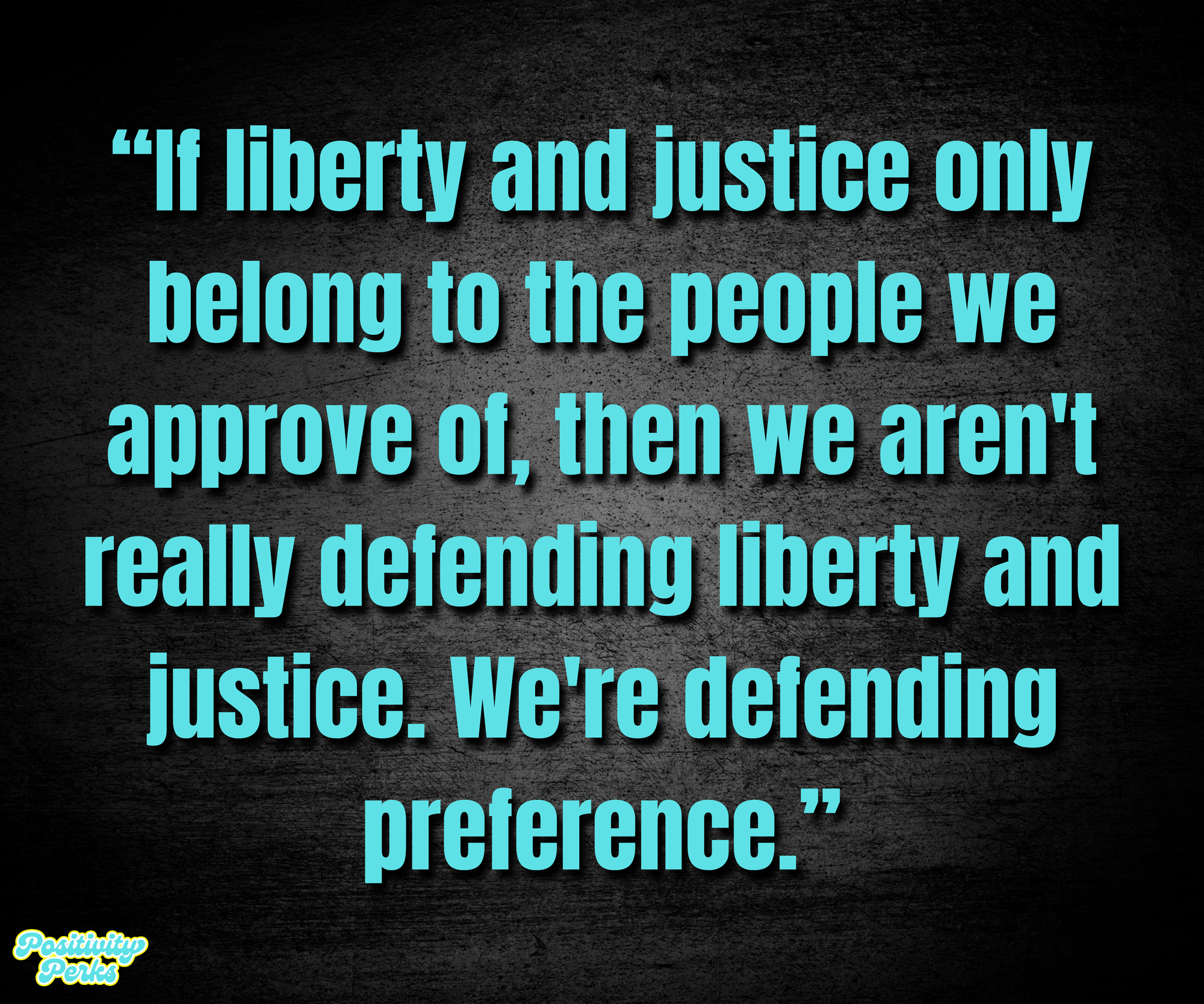
Because if liberty and justice only belong to the people we approve of, then we aren't really defending liberty and justice. We're defending preference.
And preference is easy.
Character is harder.
So perhaps staying positive isn't about convincing ourselves that the world is good.
Perhaps it is about refusing to become worse because the world isn't.
That is a much harder promise.
It is also one we can actually keep.
We can be the person who lowers the temperature instead of raising it. We can choose a conversation over a caricature. We can tell the truth without enjoying the pain it causes. We can stand firmly for what we believe and still leave room for another human being to be human.
And when everything gets loud—and it will—maybe we should remember those words from the classroom.
Not because somebody told us to say them.
Because we finally understand what they ask of us.
With liberty and justice for all.
The little word we kept overlooking was all.
Turns out it was the whole point.


👆👆CHECK OUT OUR LATEST VIDEO👆👆