The Biggest Lie Your Bad Days Want You to Believe (Don't Fall for It)
Human beings possess an almost supernatural talent for conducting unfair trials against themselves. We appoint our insecurities as prosecutors, call our fears to the witness stand, allow yesterday's mistakes to testify without objection


Human beings possess an almost supernatural talent for conducting unfair trials against themselves. We appoint our insecurities as prosecutors, call our fears to the witness stand, allow yesterday's mistakes to testify without objection, and then, before the evidence has even been examined, quietly declare ourselves guilty. The sentence? "Not good enough." "Not strong enough." "Too late." "Not the person I thought I was." It would almost be comical if it weren't so devastatingly common. Somewhere between childhood and adulthood, many of us began believing that a difficult day wasn't merely something we experienced—it was something that exposed who we truly were. And just like that, fatigue became failure. Grief became weakness. One setback became a character reference. What an astonishingly cruel misunderstanding of what it means to be alive.
The irony is impossible to ignore. We readily excuse the weather for changing its mind. We don't curse winter because it isn't spring. We don't accuse the ocean of inconsistency because today's waves refuse to resemble yesterday's. Nature is allowed to fluctuate without apology, to cycle, to retreat, to gather strength before returning. Yet somehow we expect ourselves to exist in a permanent state of emotional competence, forever productive, endlessly patient, unwaveringly optimistic, as though possessing a heartbeat should exempt us from the very rhythms that govern every living thing. Then, when life inevitably reminds us that we are flesh and blood instead of granite and steel, we act surprised. Worse, we act ashamed. The expectation was never realistic. The disappointment, therefore, was inevitable.
The truth—less glamorous perhaps, but infinitely more liberating—is that bad days are not interruptions to a meaningful life. They are part of its architecture. They belong there. They always have. Every person you've ever admired has lived through mornings when getting dressed felt strangely heroic, afternoons when self-doubt spoke with unbearable confidence, evenings when silence seemed louder than conversation. The difference is not that extraordinary people avoid these moments. It's that, eventually, they stop negotiating with every emotion that knocks on the front door of their mind. They learn that feelings deserve acknowledgment without automatically receiving authority. Not every thought deserves belief. Not every fear deserves obedience. Not every emotional storm deserves to become tomorrow's forecast.
Besides, your mind is a spectacular storyteller, but it is also an unapologetic dramatist. Catch it on the wrong day and it will transform a single awkward conversation into social exile, one mistake into lifelong incompetence, one closed door into proof that every future opportunity has secretly resigned. It doesn't simply whisper; it performs. It adds dramatic lighting. It hires an orchestra. It writes a tragic ending before the first act has even finished. If your inner critic ever won an award, it would undoubtedly be for Best Performance in a Completely Fictional Narrative. The problem, of course, is that we often buy tickets to the show. We sit in the front row, applaud the performance, and mistake emotional intensity for objective truth. They are not remotely the same thing.
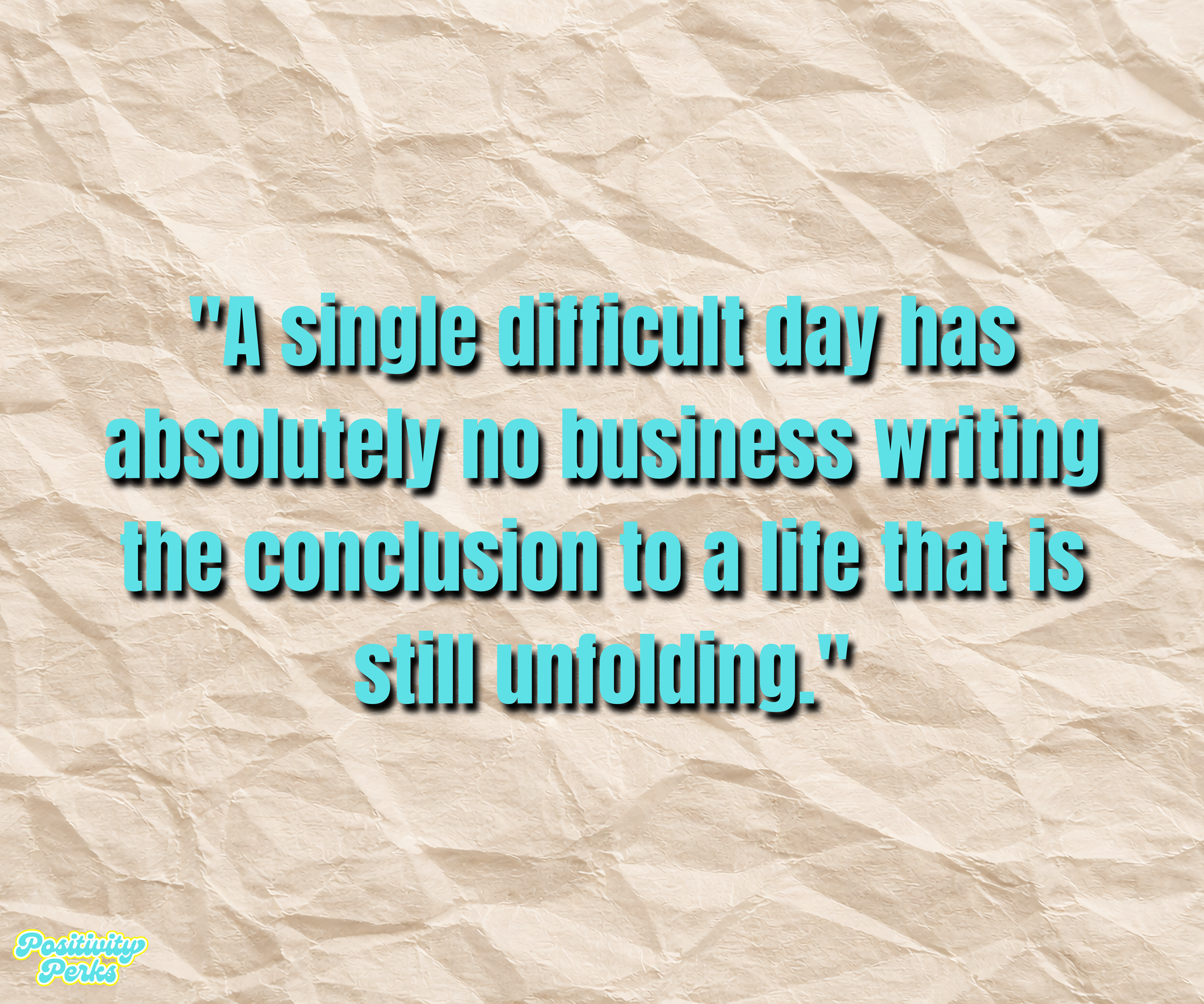
Real positivity has never required pretending that everything is wonderful. That version of optimism is exhausting because it demands dishonesty. Genuine positivity is considerably more rugged than that. It looks life directly in the eye, acknowledges the disappointment without decorating it, admits the heartbreak without surrendering to it, and somehow retains the quiet courage to believe that today's reality is not tomorrow's identity. That isn't denial. It's wisdom. Wisdom understands that a single page cannot summarize an entire novel, a single season cannot explain an entire climate, and a single difficult day has absolutely no business writing the conclusion to a life that is still unfolding.
So, if today feels unusually heavy—if your smile has become expensive, your patience unusually short, your hope annoyingly difficult to locate—grant yourself something our achievement-obsessed culture rarely encourages: permission to remain wonderfully, imperfectly human. Rest without guilt. Cry without embarrassment. Laugh whenever life unexpectedly gives you a reason, even if it arrives at the most inappropriate moment. Ask for help. Step away from perfection's impossible demands. Then, when your strength quietly returns—as it almost always does—stand up again, brush the dust from your spirit, and continue the journey. Not because you suddenly became fearless. Not because the road magically became easier. But because your worth has never been determined by the quality of your hardest day, and your potential has never once asked for uninterrupted confidence. It has only ever asked that, after life has finished teaching today's lesson, you choose not to mistake the classroom for your permanent address.
Be positive, and have a wonderful day!
 Russell B
SUBSCRIBE FOR FREE TODAY!