Most People Aren't Rude—They're Exhausted.
" Real positivity is the discipline of choosing understanding when misunderstanding would be easier."


One of the strangest contradictions of adulthood is discovering that nearly everyone you meet is carrying something heavy, yet very few people talk about the weight. They smile. They show up. They answer emails. They attend meetings. They post vacation photos and birthday celebrations and inspirational quotes. From a distance, everything appears normal. Functional. Fine. But life has a way of teaching us that appearances are often nothing more than beautifully decorated wrapping paper surrounding battles nobody can see. The man standing in front of you at the grocery store may be wondering how he's going to pay his bills. The woman who seems distracted at work may have spent the entire night sitting beside a hospital bed. The friend who hasn't returned your messages may be fighting a war inside their own mind that requires every ounce of energy simply to get through the day. Yet despite knowing how complicated our own lives are, we routinely assume simplicity in the lives of others. It's a curious flaw in human nature. We understand our struggles in chapters, but we judge other people's struggles from a single sentence.
The truth is, empathy becomes more difficult precisely when it becomes most necessary. It's easy to be patient when you're rested, comfortable, appreciated, and everything is unfolding according to plan. Anyone can be kind under ideal circumstances. That's not character. That's convenience. Character reveals itself when your patience is already running low, your schedule is overloaded, your stress level is climbing, and someone else's behavior gives you a perfectly reasonable excuse to react poorly. In those moments, something fascinating happens. We stand at an invisible crossroads. One path leads toward assumption, judgment, irritation, and self-righteousness. The other requires curiosity. Humility. Restraint. Unfortunately, the first path feels better in the moment. It gives the ego a snack. It allows us to feel superior. It lets us believe we possess information we do not actually have. The second path demands something much harder: the willingness to admit that we may not know the whole story.
And let's be honest—our minds are remarkably creative when information is missing. A text message goes unanswered for six hours, and suddenly we've written an entire screenplay. Someone appears distant, and we've already assigned motives, intentions, and character flaws before a single conversation has occurred. Human beings are meaning-making machines. We connect dots that were never connected. We invent explanations because uncertainty makes us uncomfortable. Yet some of the greatest misunderstandings in history, in friendships, in marriages, in families, and in workplaces have emerged from conclusions drawn without evidence. The reality is often far less dramatic and far more human. Most people are not plotting against you. Most people are not intentionally trying to hurt you. Most people are simply overwhelmed, distracted, exhausted, frightened, grieving, or doing the best they can with tools they never asked to need.
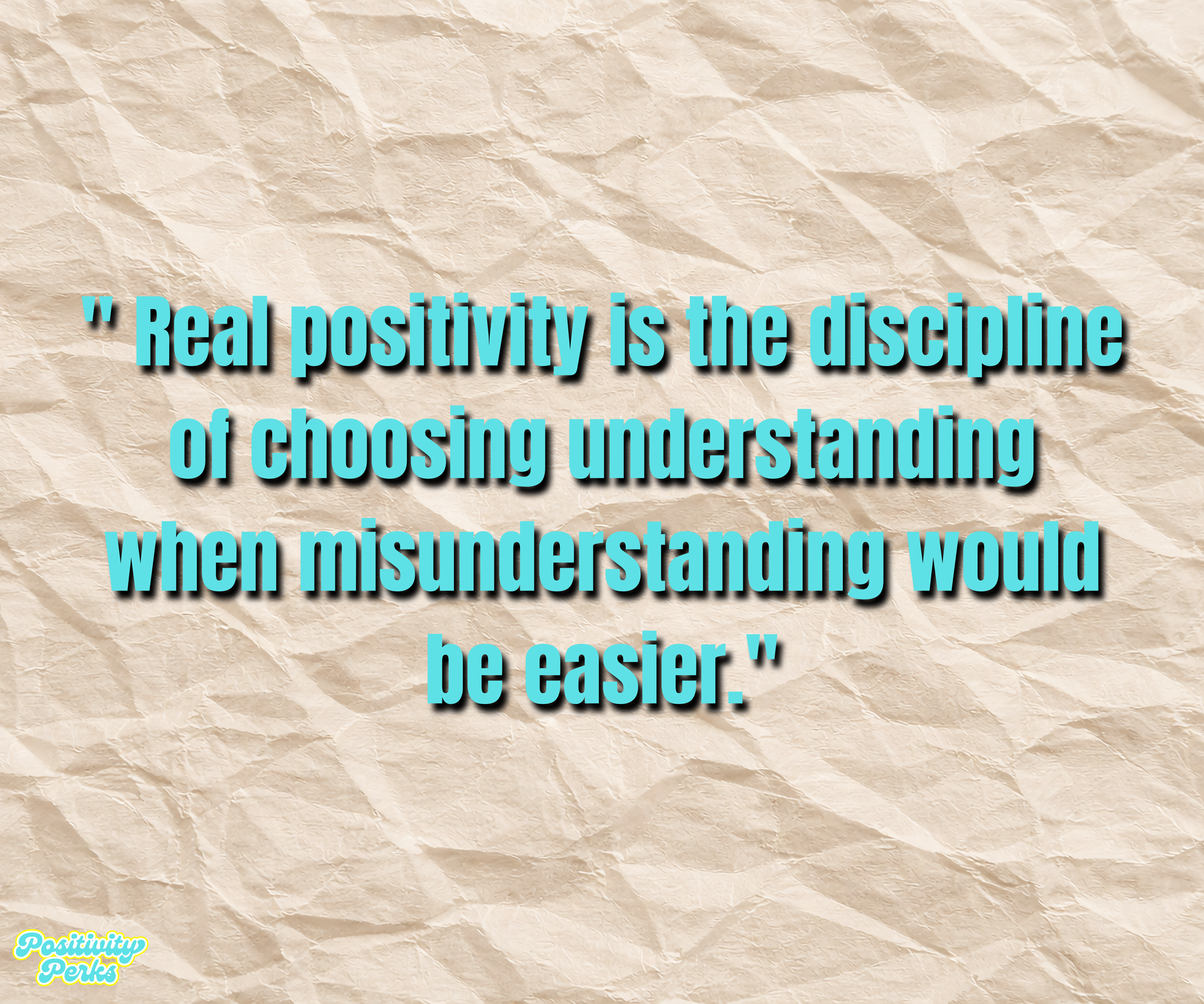
Positivity, therefore, is not the act of ignoring difficult people or pretending every interaction should be wrapped in sunshine and motivational slogans. That's fantasy. Real positivity is far more rugged than that. It is the discipline of choosing understanding when misunderstanding would be easier. It is the refusal to allow someone else's bad moment to dictate the quality of your character. It is the ability to recognize that pain often disguises itself as anger, fear frequently masquerades as control, and loneliness can sometimes wear the face of indifference. The person who needs compassion the most is rarely the person making it easiest to give. That's the uncomfortable truth many people avoid. Empathy is not tested when someone is lovable. It is tested when they are difficult.
Perhaps that is why compassion possesses such extraordinary power. It interrupts cycles. It softens conflicts before they become wars. It creates breathing room where judgment once lived. More importantly, it protects something precious inside of us. Because every time we choose resentment, we carry it. Every time we choose bitterness, we become responsible for its weight. Every time we allow ourselves to view people only through the lens of their worst moments, we slowly train our hearts to expect the worst from humanity. And what a tragic way to move through life. The world already contains enough cynicism. Enough outrage. Enough people waiting to be offended. What it desperately needs are individuals brave enough to remain compassionate without becoming naïve, strong enough to remain kind without becoming weak, and wise enough to understand that empathy is not merely a gift we give to others. It is a gift we give to ourselves. Because in the end, one of life's greatest victories is reaching a point where hardship did not harden you, disappointment did not poison you, and pain did not convince you to stop caring. Instead, it taught you how desperately every human being needs a little more patience, a little more understanding, and a little more grace than they are willing to admit.
Be positive, and have a wonderful day!
 Russell B
SUBSCRIBE FOR FREE TODAY!