Stop Waiting to Change the World—You're Already Changing It.
"Communities are rarely transformed by dramatic moments. They are transformed by millions of beautifully ordinary decisions made by people who finally understand that greatness has never been measured by the size of the gesture—only by the size of the heart behind it."


One of the most persistent misunderstandings ever to settle comfortably into the human imagination is the belief that significance must announce itself loudly. We have somehow convinced ourselves that changing a community requires microphones, movements, enormous bank accounts, public recognition, or the kind of résumé that makes strangers nod in admiration. It's an attractive story because it quietly excuses the rest of us. After all, if greatness belongs only to the exceptionally gifted, then ordinary people are free to remain comfortably ordinary. We can keep our heads down, mind our own business, scroll endlessly through everyone else's accomplishments, and reassure ourselves that someone more qualified will eventually step in.
History, however, has always been spectacularly unimpressed with that philosophy.
Civilizations have not endured because millions of people performed extraordinary acts. They have endured because ordinary people repeatedly chose decency over indifference, generosity over convenience, patience over irritation, and responsibility over the seductive comfort of saying, "That's someone else's problem." The headlines celebrate heroes. Communities survive because of neighbors.
Somewhere along the way, we've become obsessed with measuring impact by visibility. If nobody notices the kindness, did it really matter? If it wasn't photographed, posted, liked, shared, celebrated, or rewarded, was it worth doing at all? It's a strange question, isn't it? The roots of an oak tree spend their entire existence hidden beneath the surface, unnoticed by nearly everyone, yet remove them and the towering tree collapses with astonishing speed. The most essential things in life have always been remarkably poor at attracting attention.
Character works much the same way.
The person who quietly returns the misplaced wallet without expecting gratitude will probably never appear on the evening news. Neither will the woman who visits an elderly neighbor every Thursday simply because loneliness shouldn't become anyone's permanent roommate. The father coaching Little League after working a ten-hour shift isn't seeking applause. The teenager who stops to help someone change a flat tire isn't building a personal brand. They're simply doing what healthy human beings have always done when they recognize that life was never intended to be lived as a collection of disconnected individuals occupying adjacent addresses.
Here's the uncomfortable part.
Every single one of us is already shaping our community.
Not occasionally.
Not accidentally.
Constantly.
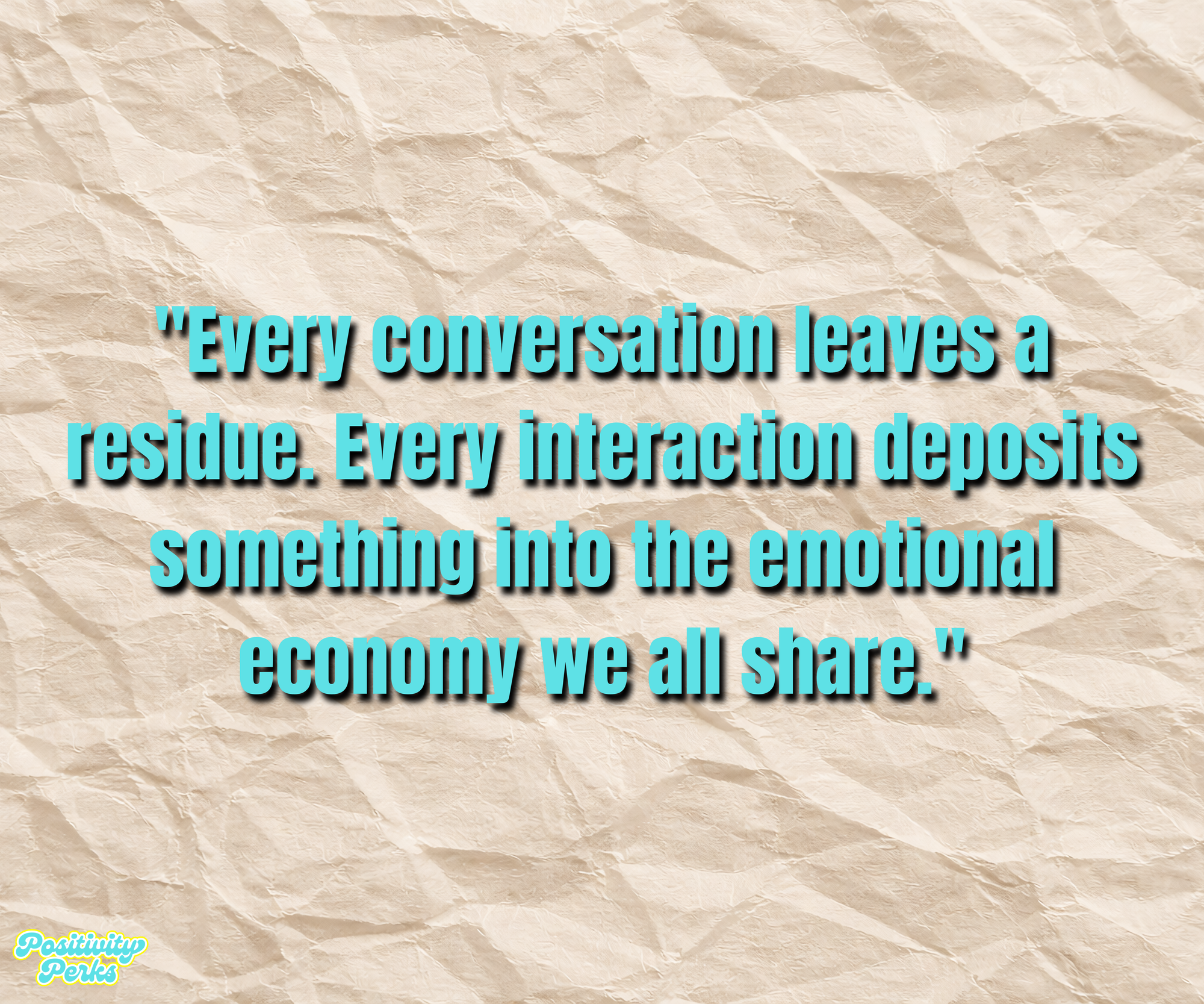
Every conversation leaves a residue. Every interaction deposits something into the emotional economy we all share. Some people distribute hope without realizing it. Others scatter discouragement with equal efficiency. Some walk into a room and make everyone feel seen. Others arrive carrying criticism so effortlessly that the atmosphere itself seems to tighten around them. The remarkable thing isn't that we influence one another. The remarkable thing is how often we pretend we don't.
Negativity has a peculiar talent for disguising itself as realism. You've met people like this. Perhaps you've been one on a particularly exhausting Tuesday. They proudly announce they're "just telling it like it is," as though cynicism were evidence of superior intelligence. But let's call this what it often becomes: emotional laziness. Anyone can identify what's broken. Newspapers have built entire industries around that skill. Social media has practically perfected it. Pointing at darkness has never required courage. Carrying a flashlight always has.
Real positivity isn't naïve. It isn't pretending the world has no fractures. It isn't smiling through heartbreak or ignoring injustice because optimism feels more comfortable than reality. Genuine positivity stares hardship directly in the face, acknowledges every crack in the foundation, and then asks the far more difficult question:
"What can I build anyway?"
That single question has quietly transformed neighborhoods, schools, families, friendships, churches, workplaces, and entire generations.
Consider how astonishingly modest most meaningful contributions actually are. A handwritten note thanking a teacher who was beginning to wonder whether anyone noticed. Five extra minutes spent listening instead of waiting impatiently for your turn to speak. Picking up litter in a park you'll probably never visit again. Supporting a struggling local business instead of automatically choosing the cheapest online option. Delivering soup to a sick friend. Offering forgiveness before pride has an opportunity to draft another argument. Welcoming the new family on the block before they spend six lonely months wondering whether anyone knows they exist.
None of these actions will alter the rotation of the earth.
Yet every one of them changes the world someone is currently living in.
And perhaps that's the only definition of changing the world that has ever truly mattered.
We often underestimate small acts because we insist on evaluating them immediately. Human beings are impatient accountants. We want instant returns on emotional investments. We want proof that today's kindness produced tomorrow's miracle. Life rarely cooperates with those demands. Compassion is less like flipping a light switch and more like planting an orchard. You may never sit beneath every tree your kindness helps grow. Someone else will. That does not diminish the value of planting it.
Imagine, for a moment, what would happen if every person reading these words decided to contribute just one intentional act of goodness every day—not for recognition, not for praise, not because it would look admirable online, but because contributing to the well-being of others became as ordinary as brushing their teeth. Imagine neighborhoods where encouragement became contagious, where generosity spread more rapidly than outrage, where people competed to out-serve rather than out-shout one another. It sounds almost idealistic.
Until you remember that every healthy culture in history began with individuals making decisions long before they became traditions.
Perhaps we've been asking the wrong question all along.
Instead of wondering whether one person can really make a difference, maybe we should ask what kind of community would exist if every ordinary person believed they couldn't.
That answer should unsettle us.
Fortunately, there's another answer available.
Become the neighbor who waves first.
Become the volunteer who quietly shows up.
Become the customer who thanks the exhausted cashier.
Become the mentor who remembers what it felt like to be uncertain.
Become the friend who calls before being asked.
Become the stranger who restores someone else's faith in humanity without ever learning their name.
Because communities are rarely transformed by dramatic moments.
They are transformed by millions of beautifully ordinary decisions made by people who finally understand that greatness has never been measured by the size of the gesture.
Only by the size of the heart behind it.
So go leave your corner of the world a little brighter than you found it. Odds are, someone you've never met is waiting for exactly the kindness you almost convinced yourself was too small to matter.
It never was.
It never will be.
Be Well. Be Positive.
Be positive and have a wonderful day!


👆👆CHECK OUT OUR LATEST VIDEO👆👆